TLDR: Guy Hovis and Ralna English were the most popular act on The Lawrence Welk Show from 1969 to 1982, beloved by audiences as a perfectly matched married couple. In reality they had secretly separated in 1978, four years before the show ended, and kept it hidden to protect their brand.
They divorced in 1984, reunited professionally years later, and kept performing together until Guy Hovis passed away on January 22, 2026, at age 84.
For twelve years, audiences watched Guy Hovis and Ralna English sing together on The Lawrence Welk Show and saw exactly what they were supposed to see: two people deeply in love, harmonizing their way through life as naturally as breathing.
What those audiences didn’t know was that for the final four years of the show, the marriage was already over.
Guy and Ralna had separated in 1978 and made a quiet professional agreement to keep it secret until the show ended. Every performance after that, every close-up, every romantic duet, was a sustained act of professionalism that their most devoted fans never suspected. It is one of the more remarkable stories in American variety television.
Guy Hovis Grew Up in Tupelo and Went to School With a Future Senator
Guy Lee Hovis Jr. was born on September 24, 1941, in Tupelo, Mississippi, the same city that produced Elvis Presley a few years earlier. The parallels end there. Where Elvis came from poverty and disruption, Hovis grew up in a household defined by discipline and structure. His father was an original member of the Mississippi Highway Patrol.
He started singing at five years old in the Harrisburg Baptist Church, and the gospel quartet tradition of the American South shaped everything about how he approached music. Sincerity was the technique. Connection was the goal.
At the University of Mississippi he earned a degree in accounting and formed a vocal group called the Chancellor’s Quartet with a few fraternity brothers, one of whom was a young Trent Lott. That friendship would resurface decades later in a very different context.
After Ole Miss, Hovis completed Artillery Officer Candidate School at Fort Sill and Paratrooper School at Fort Benning before heading to Los Angeles in the mid-1960s to try his luck in the music business. He performed with a vocal duo called Guy and David, appeared on Art Linkletter’s House Party, and was working the California circuit when he met Ralna English.
Ralna English Once Beat Buddy Holly in a Battle of the Bands
Ralna Eve English was born on June 19, 1942, in Haskell, Texas, and grew up in the small town of Spur before her family moved to Lubbock when she was eleven. Lubbock in the 1950s was a genuine musical hothouse, and English was at the center of it.
She started performing professionally at thirteen. At Lubbock High School, her group, Ralna and the Ad-Libs, entered a local battle of the bands and defeated Buddy Holly and the Crickets. It is the kind of detail that sounds too good to be true and is nonetheless documented.
After Texas Tech University she moved into the professional circuit with characteristic intensity. She spent her afternoons at a Dallas recording studio cutting commercial jingles and her evenings singing jazz in clubs, a dual schedule that gave her a technical precision most performers her age didn’t have.
She eventually landed in Santa Monica at a nightclub called The Horn, a serious venue where she shared bills with Steve Martin, Vicki Carr, and Jack Jones. It was there she met Guy Hovis. They married on January 25, 1969.
How They Ended Up on the Lawrence Welk Show
Ralna got there first. She auditioned for the Welk organization and was told there were no current openings but that he would call if something changed. A few months later he did, and she joined the show as a soloist in mid-1969.
She then worked to get Guy in.
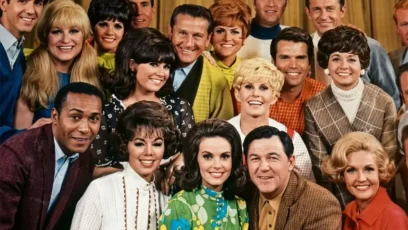
She convinced Welk to let him perform a duet with her on the 1969 Christmas special. The audience response was immediate and overwhelming. Fan mail poured in. By early 1970, Hovis was a permanent member of the Musical Family.
Together they released ten albums during their Welk tenure, with Hovis producing eight of them. Their repertoire covered country, gospel, big band, and pop. Ralna’s signature performance of “How Great Thou Art,” delivered at Madison Square Garden to 22,000 people who responded with a long silence before erupting in applause, became one of the show’s most remembered moments.
The Marriage Was Falling Apart While the Cameras Kept Rolling
By 1978 the marriage had broken down. Their personalities were fundamentally different, and the pressures of building a shared career while managing a marriage had worn through whatever foundation they had started with.
Their daughter Julie was born in October 1977. By 1978, they had legally separated.
They agreed not to tell anyone until the show ended. The audience who adored them as a couple would be devastated, the brand would suffer, and neither of them wanted to deal with the fallout while still obligated to perform together every week. So they didn’t tell anyone.
For four years, they stood side by side under the lights, sang into the same microphone, and smiled for the cameras. Ralna later said the psychological strain of performing that role while the marriage was over was profound.
In April 1980 it became untenable.
She described what happened as a breakdown, a collapse under the cumulative weight of maintaining a public fiction. She described a spiritual experience during her recovery that she credited with giving her the strength to see it through to the end of the show.
The Lawrence Welk Show ended its original run in 1982. Guy and Ralna officially divorced in 1984. When the news became public it genuinely shocked a portion of their audience who had watched them perform as a couple for over a decade and never doubted what they were seeing.
Guy Hovis Went Back to Mississippi and Into Politics
After the divorce, Hovis returned to Mississippi and reconnected with his old fraternity brother Trent Lott, who was by then building a significant political career. When Lott was elected to the Senate in 1988, he brought Hovis on as Director of State Operations, a role Hovis held for seventeen years.
He was effective at it. His natural charm and residual fame from television made him an asset at political events across Mississippi. At gatherings like the Neshoba County Fair, he would emcee and perform, warming up crowds before Lott’s appearances.
In the mid-1990s, Hovis became involved in one of the more unlikely musical projects in American political history.
He helped coordinate the Singing Senators, a barbershop quartet made up of Trent Lott, John Ashcroft, Larry Craig, and Jim Jeffords. The group performed at the Kennedy Center, on the Today Show, and at the 1996 Republican National Convention. Hovis performed alongside them at Mississippi events.
In 2005 he sang “Let the Eagle Soar” at the second inauguration of President George W. Bush.
Ralna English Built a Solo Career in Arizona
Ralna relocated to Scottsdale, Arizona, and built the solo career she had set aside during the Welk years. She performed regularly on the Arizona jazz and concert circuit, appearing at venues like the ASU Kerr Cultural Center.
Her repertoire expanded into the Great American Songbook, and reviews consistently praised the intimacy and warmth she brought to the material.
In 2007, PBS aired Ralna English: From My Heart, a solo special that featured her performing with a 75-piece orchestra and a 100-voice choir. It was the fullest showcase of what she could do on her own, four decades after she had first stood up in front of an audience in Lubbock.
She remained connected to the Welk family, performing regularly in Branson with the Lennon Sisters and continuing to appear on the annual Live Lawrence Welk Show tours. As of 2026, she is 83 and still performing.
They Kept Performing Together for Decades After the Divorce
After some initial distance following the 1984 divorce, Guy and Ralna eventually returned to performing together. The audience still wanted to see them, and they discovered that working together again was genuinely enjoyable rather than painful.
In interviews from their later years, both spoke about the reunion with a lightness that suggested they had genuinely made peace with the whole complicated arc.
They joked about their “senior citizen” status. They talked about having fun on the road together. They performed at state fairs, PBS reunion specials, and concert tours for an audience that had followed them since the early 1970s.
They appeared together in the 2004 PBS special Lawrence Welk: Precious Memories, singing their old harmonies and reflecting on what the show had meant to them.
The chemistry that had made audiences love them in the first place was still there, detached now from the marriage that had originally produced it but intact as something that belonged to the music itself.
Their daughter Julie connected them permanently regardless of how their personal relationship evolved. When Ralna spoke about Guy in his final years, it was with the warmth of someone who had shared something irreplaceable with another person, even if it hadn’t worked out the way either of them had planned.
Guy Hovis Passed Away in January 2026
Guy Hovis died peacefully in Oxford, Mississippi, on January 22, 2026, at the age of 84, following a period of illness. He was survived by his wife of 24 years, Sarah “Sis” Lundy Hovis, his daughter Julie, and several stepchildren and grandchildren.
Ralna English posted publicly about his passing, saying she had spoken with him shortly before he died and had been deeply worried about him.
She asked for prayers for his family. It was exactly the kind of response you would expect from someone who had spent more than half a century bound to another person by music, marriage, parenthood, and the particular shared experience of having performed the same role for an audience of millions.
He had started out singing in a Baptist church in Tupelo at five years old. He ended up a Mississippi political figure, a PBS television veteran, and one half of one of the most unusual professional partnerships in American entertainment history.
The harmony outlasted the marriage by forty years. That’s not nothing.