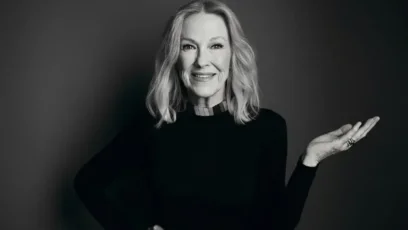
Erin Moran, who played Joanie Cunningham on Happy Days for 11 seasons, died on April 22, 2017, from complications of Stage 4 throat cancer, not from a drug overdose as initially rumored.
After losing her California home to foreclosure in 2010, she spent her final years living in Indiana with her husband Steve Fleischmann, struggling financially despite a 2012 legal settlement with CBS over unpaid merchandising royalties.
For millions of Americans who grew up watching Happy Days, Joanie Cunningham represented the wholesome, optimistic spirit of 1950s America.
Erin Moran brought that character to life across 234 episodes from 1974 to 1984, becoming a beloved fixture in American living rooms for an entire generation.
But the contrast between the idealized world of the Cunningham family and Moran’s own final years could not have been more stark.
When she died in a modest Indiana trailer home at age 56, the initial speculation focused on substance abuse and personal failure. The truth, however, tells a very different story about structural inequities in the television industry, the challenges of child stardom, and a woman who faced her final battle with quiet dignity.
From Child Star to America’s Little Sister
Erin Moran was already a television veteran by the time she joined Happy Days at age 13.
Born on October 18, 1960, in Burbank, California, she had logged appearances on Gunsmoke, My Three Sons, and a recurring role on Daktari before Garry Marshall cast her as Joanie, the younger sister of Ron Howard’s Richie Cunningham.
What started as a supporting role evolved into something much larger.
As Happy Days dominated the ratings throughout the late 1970s, Moran grew up on screen, transforming from “Shortcake,” the precocious kid sister, into a young woman who could anchor her own storylines.
The chemistry between Moran and Scott Baio, who played Chachi Arcola, became so popular that ABC and Paramount developed the spinoff Joanie Loves Chachi in 1982.
The decision proved to be a turning point in Moran’s career, though not in the way anyone expected.
According to retrospective interviews, Moran was initially resistant to the spinoff. She had found security and genuine affection within the Happy Days ensemble cast, which she frequently described as her real family.
The pressure to relocate her character to Chicago and pivot toward a musical comedy format felt like a departure from everything that had made the original show successful.
When Joanie Loves Chachi was cancelled in 1983 after only 17 episodes and two seasons, Moran returned to Happy Days for its final season. But the damage to her professional trajectory was already done.
Hollywood’s perception of her as a bankable lead had been compromised. The failed spinoff became a shadow that followed her into what should have been the prime years of her adult career.
The Money That Never Came
The popular narrative about former child stars often centers on reckless spending and poor financial choices.
In Moran’s case, the reality was far more systemic. The television contracts of the 1970s, negotiated during what many call the “Golden Age” of sitcoms, lacked the backend residuals and syndication provisions that became standard in later decades.
While Happy Days went into massive international syndication and spawned an empire of merchandising, the actors who made it possible saw relatively little of that wealth.
In April 2011, Moran joined fellow cast members Anson Williams, Don Most, Marion Ross, and the estate of Tom Bosley in a $40 million lawsuit against CBS, which owned the rights to the show.
The lawsuit revealed just how extensively the Happy Days brand had been exploited. The actors’ images appeared on slot machines in Las Vegas casinos, on T-shirts and lunch boxes, in comic books, and across countless DVD covers.
According to their original contracts, the cast was supposed to receive 5% of net proceeds if their individual image was used, or 2.5% if they appeared as part of a group.
CBS’s defense was blunt.
The network claimed the actors were “ignorant of, or slept upon their own rights” and estimated that the actual amounts owed were far less than the millions claimed, somewhere between $8,500 and $9,000 per person.
The most contentious issue was the “handling fee,” a practice where the studio deducted 50% off the top before calculating any royalties. The cast argued this violated the spirit of fair dealing and amounted to creative accounting designed to minimize their payments.
The case settled in July 2012. Each plaintiff received $65,000 and a promise from CBS to honor the contractual terms going forward.
For Moran, who had already lost her Palmdale, California, home to foreclosure in 2010, the settlement was a temporary reprieve but nowhere near enough to restore her financial stability.
By the time of her death, family members described her as essentially penniless, having exhausted the settlement funds on debt and basic living expenses.
The Move to Indiana and Years in Limbo
After the foreclosure stripped away her home and what remained of her California life, Moran and her husband Steve Fleischmann made a decision that surprised many who knew her.
In 2011, they relocated to Corydon, Indiana, a small town in Harrison County, to live with and care for Fleischmann’s ailing mother.
Moran had married Fleischmann in 1993, and by all accounts, their relationship remained solid even as the financial pressures mounted.
The move to Indiana represented an attempt to escape the industry that had “chewed her up and spat her out,” as one advocate for former child actors later described it.
The transition, however, was anything but peaceful.
In September 2012, the couple was ejected from the mother-in-law’s trailer following what family members described as an “ugly altercation” involving excessive partying.
What followed was a period of transient living that bordered on homelessness. Moran and Fleischmann cycled through local motels, including the Holiday Inn Express in Corydon, where Moran was eventually asked to leave following reports of behavioral disturbances.
During this period, Moran became a familiar face at local establishments.
Amanda Richard, a bartender at O’Charley’s, later recounted that Moran spent significant time at the bar during her stay at the Super 8 motel.
Richard remembered her as friendly but visibly depressed, often expressing deep sadness over her financial situation and the loss of her star status.
At other local taverns like Beef O’Brady’s, Moran would share stories of her Hollywood years with strangers, occasionally becoming “overly loud” as the evening wore on.
By 2017, the couple had found more permanent housing in a modest trailer park in New Salisbury, Indiana. Fleischmann supported them through his job at Walmart. Neighbors in this final location described Moran as kind but increasingly reclusive, someone who had begun to “hibernate” as the months passed.
What those neighbors interpreted as social withdrawal was actually the onset of a devastating medical crisis.
The Cancer That Took Her Life
When news of Erin Moran’s death broke on April 22, 2017, the internet was flooded with speculation.
Given her well-publicized struggles with alcohol and the general “downward spiral” narrative that follows many former child stars, numerous social media users and even some media outlets suggested she had died of a heroin overdose.
The rumors were so pervasive that they threatened to define her legacy until her husband and the Harrison County Coroner set the record straight.
The medical reality, as detailed in Steve Fleischmann’s open letter and the subsequent autopsy report, was both tragic and entirely unrelated to substance abuse.
In November 2016, shortly after the couple’s 24th wedding anniversary, Moran discovered blood stains on her pillow.
She initially dismissed it as a bitten tongue. But the bleeding persisted, and in December 2016, a biopsy confirmed the diagnosis: Stage 4 squamous cell carcinoma of the throat.
From January through February 2017, Moran underwent intensive treatment at the Norton Cancer Institute.
She received radiation five days a week and chemotherapy every Thursday. By mid-February, the cancer had progressed so aggressively that she lost the ability to speak, eat, or drink.
Doctors surgically implanted a gastric feeding tube to provide basic nutrition. The cancer had already metastasized to her spleen, and part of her brain had become infected.
On Saturday, April 22, 2017, which also marked the 25th anniversary of Moran and Fleischmann’s first meeting, Moran was resting in bed at their New Salisbury home.
She had been struggling with her breathing since the previous day. Fleischmann sat with her, holding her hand as they watched television together. He fell asleep for about an hour.
When he woke, Moran had passed away, still holding his hand.
The Harrison County Coroner’s autopsy provided definitive closure. The cancer had reached Stage 4 with widespread metastasis. Significant fluid had accumulated in her lungs. Comprehensive toxicology testing confirmed that no illegal narcotics were involved in her death.
The coroner stated that given the extent of the cancer and the secondary infections, Moran would not have survived even with hospitalization and heavy antibiotics. She was 56 years old.
The Scott Baio Controversy
The pain of Moran’s death was compounded by a public controversy involving her former co-star Scott Baio. On the Monday following her passing, Baio appeared on The Bernie and Sid Show on WABC radio and made comments that shocked both fans and fellow cast members.
Based on unverified internet reports suggesting a heroin overdose, Baio stated, “If you do drugs or drink, you’re gonna die.”
The backlash was immediate and intense.
Other Happy Days cast members, including Anson Williams and Don Most, expressed shock at Baio’s bluntness and emphasized Moran’s kindness while noting that many in the cast had been unaware of her cancer battle.
When the coroner’s report was released and the truth about her throat cancer became public, Baio retracted his comments and shared Fleischmann’s letter on social media.
He claimed his anger had stemmed from a fear of drugs impacting his own children and later suggested that the severity of the criticism was politically motivated, attributing it to his public support for Donald Trump and claiming that “liberal Hollywood” was using the situation to attack him.
Baio eventually expressed “heartbreak” over Moran’s death and praised her “contagious smile” and “warm heart.”
But the incident served as a painful reminder of how quickly false narratives can take hold and how difficult it can be to correct them once they spread.
The Happy Days Family Remembers
Despite the geographical distance and the years that had passed, Moran was not forgotten by her Happy Days castmates.
The narrative that she had been abandoned by Hollywood colleagues does not match the facts of their final interactions.
Henry Winkler, who often referred to Moran as his “on-screen little sister,” issued a tribute after her death that emphasized her search for peace and her inherent kindness.
Ron Howard publicly mourned his “on-screen sister,” remembering her as a talented professional who never found the stability she deserved.
Marion Ross, who played Mrs. Cunningham, hosted a gathering at her home, affectionately known as “Happy Days Farm,” in May 2017.
The cast reunion served as a private, informal memorial to celebrate Moran’s life away from the media spotlight. Anson Williams, who played Potsie, was one of the few confidants who had been aware of her medical struggle and had attempted to offer support throughout her treatment.
Paul Petersen, founder of A Minor Consideration, an organization that advocates for former child performers, noted that the help Moran needed was available in Los Angeles. But Moran had effectively “run” to Indiana, perhaps in an attempt to distance herself from an industry that she felt had failed her.
Petersen’s observation highlighted a broader systemic issue: the safety nets that should exist for former child stars often require them to remain in the very environment that contributed to their struggles in the first place.
A Legacy Beyond the Headlines
The final years of Erin Moran’s life were undeniably difficult.
The loss of her home, the period of semi-homelessness in Indiana, the financial devastation, and ultimately the terminal cancer diagnosis paint a picture of hardship that stands in stark contrast to the warmth and stability of the Cunningham household she helped bring to life.
But reducing her story to one of tragedy and failure misses something essential about who she was.
Moran remained professionally active well into the 2000s, with her final film role coming in 2012, a full 28 years after Happy Days ended. She appeared on Celebrity Fit Club in 2008, had a recurring role on The Bold and the Beautiful in 2009, and continued to take work in independent films.
Until her health failed, she remained hopeful about returning to work and contributing to the industry that had defined her life.
Her marriage to Steve Fleischmann lasted 25 years, a testament to their commitment despite the crushing pressures of poverty and illness.
She died on the anniversary of their first meeting, in his presence, receiving the care she needed in her final hours. That she spent those last months in a modest Indiana trailer rather than a California mansion speaks more to the structural failures of an industry that profited enormously from her labor than to any personal shortcoming.
For the generation of viewers who remember Joanie Cunningham as a symbol of youth and optimism in 1950s Milwaukee, the reality of Erin Moran’s end is a sobering reminder of the personhood behind the persona.
She was, as her castmates repeatedly emphasized, a woman of “big, kind soul” who never lost her warmth even as she lost nearly everything else.
The millions who grew up watching her deserved to know the truth about how she died and why her final years were so difficult.
Her story is not just one of tragedy, but of resilience, enduring love, and the human cost of an industry that too often fails to protect those who built it.
Erin Moran: Frequently Asked Questions
How did Erin Moran die?
Erin Moran died on April 22, 2017, from complications of Stage 4 squamous cell carcinoma of the throat, not from a drug overdose as initially rumored. She was diagnosed in December 2016 after discovering blood stains on her pillow in November. From January through February 2017, she underwent intensive treatment at the Norton Cancer Institute with radiation five days a week and chemotherapy every Thursday. By mid-February, the cancer had progressed so aggressively that she lost the ability to speak, eat, or drink. The cancer had metastasized to her spleen and part of her brain had become infected. She died at age 56 in her New Salisbury, Indiana home, holding her husband Steve Fleischmann’s hand.
Why was Erin Moran living in a trailer in Indiana?
After losing her Palmdale, California home to foreclosure in 2010, Moran and her husband Steve Fleischmann relocated to Corydon, Indiana in 2011 to live with and care for Fleischmann’s ailing mother. The move represented an attempt to escape the industry and find financial stability. After being ejected from the mother-in-law’s trailer in September 2012 following an altercation, the couple cycled through local motels before finding more permanent housing in a modest trailer park in New Salisbury, Indiana by 2017. Fleischmann supported them through his job at Walmart.
Did Erin Moran receive money from Happy Days royalties?
In April 2011, Moran joined fellow cast members in a $40 million lawsuit against CBS over unpaid merchandising royalties. The cast argued their images appeared on slot machines, T-shirts, lunch boxes, comic books, and DVD covers without proper compensation. The case settled in July 2012 with each plaintiff receiving $65,000 and a promise from CBS to honor contractual terms going forward. For Moran, who had already lost her home to foreclosure in 2010, the settlement was a temporary reprieve but nowhere near enough to restore financial stability. By the time of her death, family members described her as essentially penniless.
What did Scott Baio say about Erin Moran’s death?
On the Monday following Moran’s death, Scott Baio appeared on The Bernie and Sid Show on WABC radio and suggested she died from drugs, stating If you do drugs or drink, you’re gonna die. The backlash was immediate and intense from other Happy Days cast members. When the coroner’s report confirmed she died from Stage 4 throat cancer with no illegal narcotics involved, Baio retracted his comments and shared her husband’s letter on social media. He claimed his anger stemmed from fear of drugs impacting his own children and later suggested the criticism was politically motivated due to his support for Donald Trump.
Was Erin Moran homeless before she died?
Moran experienced a period of transient living that bordered on homelessness between 2012 and 2017. After being ejected from her mother-in-law’s trailer in September 2012, she and her husband cycled through local motels including the Holiday Inn Express in Corydon, where she was eventually asked to leave following reports of behavioral disturbances. During this period, she spent significant time at local bars and was described by bartenders as friendly but visibly depressed over her financial situation. By 2017, the couple had found more permanent housing in a modest trailer park in New Salisbury, Indiana.
How long was Erin Moran on Happy Days?
Erin Moran played Joanie Cunningham on Happy Days for 11 seasons from 1974 to 1984, appearing in 234 episodes. She joined the cast at age 13 as the younger sister of Ron Howard’s Richie Cunningham. The chemistry between Moran and Scott Baio led to the spinoff Joanie Loves Chachi in 1982, which was cancelled after only 17 episodes and two seasons in 1983. Moran returned to Happy Days for its final season, but the failed spinoff damaged her professional trajectory and Hollywood’s perception of her as a bankable lead.
Did the Happy Days cast stay in touch with Erin Moran?
Despite geographical distance and years that had passed, Moran was not forgotten by her Happy Days castmates. Henry Winkler issued a tribute emphasizing her search for peace and inherent kindness. Ron Howard publicly mourned his on-screen sister. Marion Ross hosted a gathering at her home in May 2017 as a private memorial. Anson Williams was one of the few confidants who had been aware of her medical struggle and attempted to offer support throughout her treatment. The narrative that she had been abandoned by Hollywood colleagues does not match the facts of their final interactions.
How long was Erin Moran married to Steve Fleischmann?
Erin Moran married Steve Fleischmann in 1993, and their marriage lasted 25 years until her death in 2017. By all accounts, their relationship remained solid even as financial pressures mounted. She died on April 22, 2017, which also marked the 25th anniversary of their first meeting. Fleischmann was sitting with her, holding her hand as they watched television together when she passed away. He fell asleep for about an hour, and when he woke, Moran had passed away, still holding his hand.