
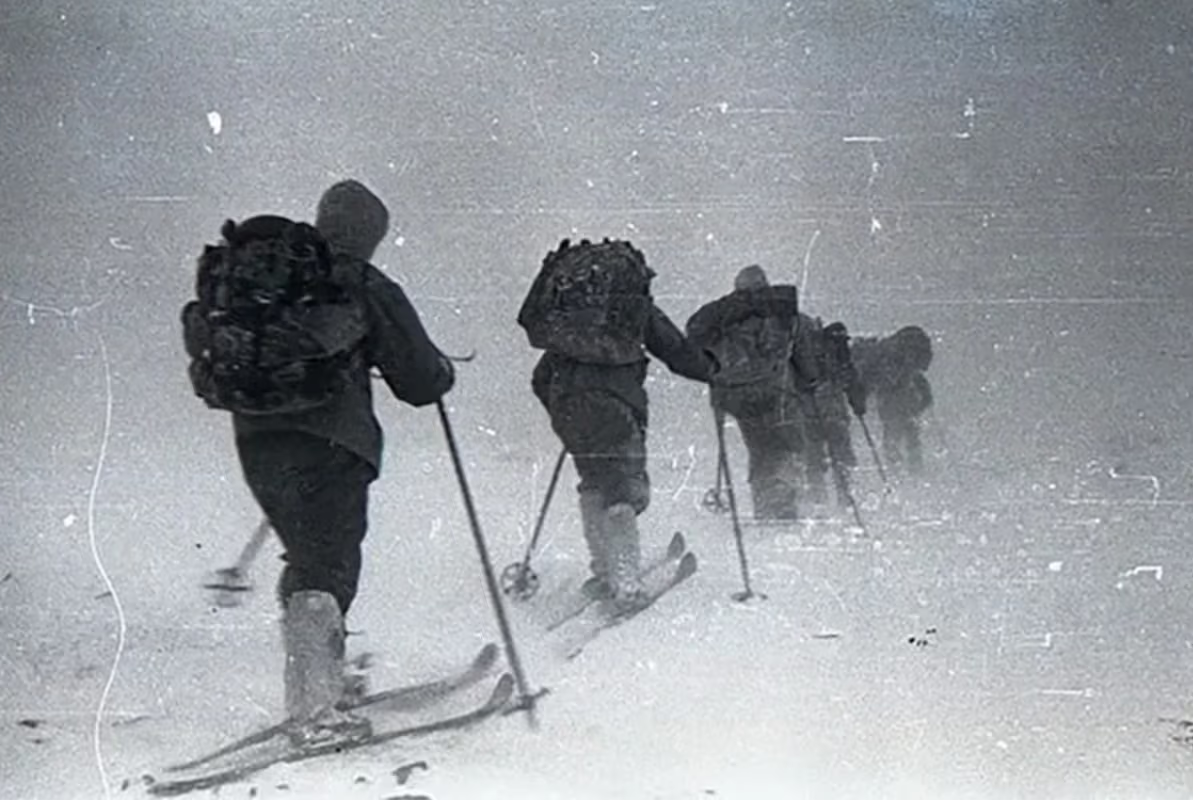
In 1959, nine experienced Russian hikers died mysteriously in the Ural Mountains under circumstances that baffled investigators for over 60 years. Their tent was cut from the inside, they fled barefoot into -40°C temperatures, and some had injuries like being hit by a car with no external wounds.
After decades of theories ranging from military accidents to aliens, Swiss scientists finally solved the mystery in 2021 using computer code originally developed for Disney’s Frozen.
For 65 years, the Dyatlov Pass incident has been Russia’s greatest unsolved mystery.
Nine experienced hikers set out on a winter trek through the Ural Mountains in January 1959. They never came back. When search teams found their camp weeks later, what they discovered made no sense whatsoever.
The tent had been cut open from the inside. The hikers had fled into the freezing night wearing almost nothing. Some were barefoot. Some wore only socks. And when the bodies were finally recovered over the following months, the injuries were horrifying and inexplicable.
Broken ribs with no external bruising. Fractured skulls. Missing tongues and eyes. One victim had injuries consistent with being hit by a car, yet there wasn’t a scratch on her skin.
The Soviet investigation concluded the hikers died from an “unknown compelling force” and closed the case. The files were classified. The area was closed to hikers for three years.
And the theories? They got wild.
Military weapons testing. Parachute mines. Indigenous tribe attacks. Escaped prisoners. Sound waves that induced panic. Even aliens and the Yeti made the list of suspects.
Then in 2021, scientists finally figured it out.
The solution involved advanced physics, biomechanical modeling, and the same computer animation code used to create the snow effects in Disney’s Frozen.
The Nine Hikers: Who They Were

This wasn’t a group of inexperienced weekend campers. These were some of the Soviet Union’s best and brightest students from the Ural Polytechnic Institute, studying radio engineering, nuclear physics, and civil engineering.
The expedition leader was Igor Dyatlov, 23, a fifth-year radio engineering student. The group included Lyudmila Dubinina, 20, the youngest member studying engineering and economics. Yuri Krivonischenko, 23, had actually worked at a nuclear facility. Alexander Kolevatov, 24, was studying nuclear physics.
The oldest member was Semyon Zolotaryov, 37, a World War II veteran and professional mountain instructor who joined the group at the last minute to help them achieve their certification.
There was also a tenth member, Yuri Yudin, 21. He’s the only reason we know as much as we do about what happened.
On January 28, Yudin suffered a flare-up of sciatica and a heart condition. He had to turn back. That decision saved his life. He was the last person outside the group to see the nine hikers alive.
The expedition was supposed to be a 190-mile roundtrip trek across the Northern Urals in winter conditions. Completing it would earn them the highest level of hiking certification available in the Soviet Union. It was challenging, sure. But this group had the skills and experience to handle it.
The Last Days: What We Know From Their Diaries
The group kept meticulous diaries and took photographs throughout their journey. These records show a well-prepared, disciplined team that was handling the trek exactly as planned.
They departed Sverdlovsk by train on January 23, 1959. By January 27, they’d reached the last inhabited settlement and began their ski trek toward Mount Otorten.
On January 31, they built a storage cache to leave behind surplus food and heavy equipment for their return trip. Standard procedure.
February 1 is when things started to go wrong, though they didn’t know it yet.
The weather turned brutal. An Arctic cold front moved in, bringing hurricane-force winds and visibility under 50 feet. In the blizzard, the group drifted off course and found themselves on the eastern slope of a mountain called Kholat Syakhl.
The name translates to “Dead Mountain” in the local Mansi language. That detail would later fuel all kinds of supernatural theories.
Around 5:00 PM on February 1, Dyatlov made a decision that would seal their fate. Instead of retreating downhill into the treeline where they’d have shelter from the wind, he decided to camp on the exposed slope.
Why? Experts think he wanted to maintain the altitude they’d gained, or maybe he wanted to test the group’s ability to handle exposed alpine camping. These were ambitious students going for their highest certification. Pushing limits was part of the challenge.
They dug a trench into the snow, pitched their tent, and settled in for a meal between 6:00 and 7:00 PM.
The last photograph on their cameras shows the tent being set up in a snowstorm.
Sometime in the early hours of February 2, everything went catastrophically wrong.
The Discovery: February 26, 1959
When the group didn’t send their scheduled telegram on February 20, the alarm was raised. Volunteer search parties went out, eventually joined by military helicopters and police.
On February 26, they found the tent.
What they saw didn’t make sense.
The tent was still standing, but it had been ripped and cut open from the inside. Not from outside, from inside. Someone had slashed their way out with a knife.
Inside the tent, food was laid out on a plate, half-eaten. Boots and warm clothing were neatly arranged. Everything suggested the group had been settling in for the night when something made them panic so badly they cut their way out of their own shelter and fled into temperatures between -25°C and -40°C.
The footprints in the snow told a strange story. Nine sets of tracks led downhill toward the forest, about a mile and a half away. The tracks showed the group had been walking slowly, in an orderly fashion. Not running. Not scattered in panic. Walking together.
Many were barefoot or wearing only socks.
On February 27, they found the first two bodies under a large cedar tree in the forest. Yuri Doroshenko and Yuri Krivonischenko were wearing only underwear. They’d built a small fire, but it had long since gone out.
Both had third-degree burns on their hands and feet. The tree branches above them were broken, suggesting they’d climbed it, possibly to see back toward the tent or to break off dry branches for the fire.
Over the next few days, three more bodies were found on the slope between the cedar tree and the tent. Igor Dyatlov, Zinaida Kolmogorova, and Rustem Slobodin had died trying to crawl back to camp. Slobodin had a fractured skull, but the medical examiner determined it wasn’t severe enough to have killed him. They all died of hypothermia.
Then the search stopped for two months while they waited for the snow to melt.
On May 4, they found the last four bodies.
These bodies were different.
The Injuries That Made No Sense
The remaining four hikers were discovered under four meters of snow in a ravine about 75 meters from the cedar tree. Lyudmila Dubinina, Semyon Zolotaryov, Alexander Kolevatov, and Nikolai Thibeaux-Brignolles had made it further than the others, but their injuries were catastrophic.
Thibeaux-Brignolles had a massive skull fracture. Bone fragments had been driven into his brain.
Zolotaryov had five broken ribs on his right side and was missing his eyeballs. There was a liter of blood in his chest cavity.
Dubinina had eleven broken ribs with multiple fracture lines. Her heart showed signs of hemorrhaging. She was also missing her tongue and eyes.
The medical examiner said the force required to cause these injuries was equivalent to a high-speed car crash. But there were no external wounds. No bruising on the skin. No cuts. The injuries were all internal.
How do you get hit hard enough to break eleven ribs without getting a single bruise on your skin?
And then there were the other strange details.
Some of the bodies had orange-colored skin. Some of the clothing was found to be radioactive, with levels up to 5,000 decays per minute. Dubinina and Zolotaryov were missing soft tissue. Eyes, tongue, parts of their faces.
The official Soviet investigation concluded on May 28, 1959 that the group had died from an “unknown compelling force” that they were unable to overcome. The case was closed. The files were classified. Nobody was allowed to hike in that region for three years.
And that’s where the theories started.
65 Years of Theories
When the Soviet government closes a case as “unknown compelling force” and immediately classifies everything, people are going to assume a cover-up. And they did.
Over the next six decades, more than 75 different theories emerged to explain what happened at Dyatlov Pass.
- The Military Weapons Testing Theory: Some witnesses reported seeing “orange spheres” in the sky that night. People theorized the hikers stumbled onto a secret weapons test. Parachute mines that exploded above the tent. Rocket fuel poisoning that caused disorientation. The Soviet military certainly had installations in the region, and they were definitely testing ICBMs from Baikonur around that time. But investigators found no evidence of an explosion, no chemical residue, and no military presence.
- The Indigenous Attack Theory: The Mansi people considered Kholat Syakhl sacred. Some theorized they attacked the hikers for trespassing. But the Mansi were known to be peaceful, there were no other footprints or tracks around the tent, and nothing was stolen from the camp. This theory fell apart quickly.
- The Escaped Prisoners Theory: Rumors spread about escaped gulag prisoners in the area who might have attacked the group. Again, no evidence. No stolen supplies, no signs of a struggle at the tent, no other tracks.
- The Infrasound Theory: In the 2010s, researcher Donnie Eichar proposed that wind patterns around the mountain peaks could have created infrasound, frequencies below human hearing that can cause irrational panic, nausea, and psychological breakdown. The idea was that infrasound drove them mad and made them flee the tent in terror. It’s an interesting theory, but it doesn’t explain the physical injuries.
- The Avalanche Theory: This was actually proposed early on, but it was quickly rejected. The slope angle where they camped was only 15-20 degrees. Avalanches don’t happen on slopes that gentle. Plus, if there had been an avalanche, the tent would have been buried or destroyed. It was still standing. The footprints leading away from the tent were orderly, not panicked. And search teams found no debris field from an avalanche.
So avalanche seemed impossible.
And then, in 2021, Swiss scientists proved it was exactly what happened.
The 2021 Breakthrough: Disney’s Frozen Solves a 62-Year-Old Mystery
Johan Gaume from the Swiss Federal Institute of Technology and Alexander Puzrin from ETH Zürich decided to take another look at the avalanche theory using modern technology.
They used computer animation software originally developed for Disney’s Frozen to simulate snow behavior. The same code that made Elsa’s ice castle look realistic was repurposed to model what happens when a snow slab breaks loose on a mountain slope.
They combined this with biomechanical data from the 1970s. Back then, General Motors was doing cadaver impact testing to design better seatbelts. They had precise measurements of how much force it takes to break human ribs and skulls.
The Swiss team put all this together and created a simulation of what could have happened that night.
First, they used drone mapping to get exact measurements of the slope. What they found was surprising. While the overall slope angle was gentle, there were local “steps” where the angle reached 28-30 degrees. That’s enough for a slab avalanche.
Second, they figured out the trigger mechanism.
When the hikers dug their trench and set up the tent, they cut into the snow layer. This created a weak point. Then, for several hours, katabatic winds blew down the mountain, depositing more and more snow on top of the existing slab. The added weight created pressure.
Between 7.5 and 13.5 hours after they made camp, the slab finally gave way.
The critical discovery was that it wasn’t a massive avalanche. It was a small, localized slab about the size of an SUV. Just a 5-meter by 5-meter section of hard-packed snow.
The simulation showed that this slab, moving at about 2 meters per second, would hit the tent with enough force to cause serious internal injuries to anyone lying on a hard surface like skis, which the hikers had arranged under their sleeping bags for insulation.
The impact would crush ribs and fracture skulls without necessarily causing external bruising because the force was distributed across a wide area through their clothing and sleeping bags.
The injuries would be painful, serious, but not immediately fatal.
Now imagine you’re in that tent. You’re suddenly hit by what feels like a collapsing ceiling. People are screaming. Some can’t breathe properly because their ribs are broken. The tent fabric is pressing down on you.
You think a massive avalanche is coming. You need to get out NOW.
Someone cuts the tent from the inside. Everyone evacuates immediately, not stopping to put on boots or grab coats because you think staying near the tent means getting buried alive.
You walk down to the treeline to build a fire and wait for the danger to pass. You’re thinking you’ll go back for supplies once it’s safe.
Except the wind is howling. The temperature is -30°C or worse. Some of your group are seriously injured. And you can’t find your way back to the tent in the dark and the blizzard.
That’s how nine experienced hikers die doing everything right.
The Science Explains the “Mysteries”
Once you understand the avalanche mechanism, the other “mysterious” details start making sense too.
The missing tongues and eyes:
This was probably the most disturbing detail, and it fed into all kinds of sinister theories. Dubinina and Zolotaryov’s bodies were lying in a stream for three months before they were found.
Eyes and tongues are soft tissue. They’re the first things that small animals and aquatic scavengers go for. Modern forensic experts see this all the time in bodies recovered from water.
The orange skin:
This is what happens to skin that’s been exposed to extreme cold and then UV radiation from sun reflecting off snow. Frostbite causes redness, then the skin mummifies in the dry, cold air. It turns a brownish-orange color. Not mysterious, just sad.
The radioactivity:
Two items of clothing had elevated radiation levels. Modern analysis explains this easily. Krivonischenko had worked at a nuclear facility doing cleanup work. His clothes likely had residual contamination.
Also, the gas lanterns the hikers used had mantles impregnated with thorium, which is slightly radioactive. When you spend weeks in close proximity to those lanterns in a small tent, traces of thorium can transfer to your clothing.
The “paradoxical undressing”:
This is actually a well-documented phenomenon in hypothermia cases. In the late stages of hypothermia, blood vessels near the skin suddenly dilate. Victims feel intensely hot, even though they’re freezing to death. They start taking off their clothes, convinced they’re overheating.
It’s tragic and counterintuitive, but it’s not mysterious. It’s a known medical fact.
The orderly footprints:
People always pointed to this as evidence against panic. If they were fleeing in terror, wouldn’t they be running?
But think about the situation.
They’ve just been hit by what they think is the leading edge of an avalanche. They know that running in deep snow in the dark is a good way to fall and get injured. They walk in a group, deliberately, toward the treeline where they know they’ll be safe from further slides.
This isn’t evidence against the avalanche theory. It’s evidence that these were smart, trained hikers who knew what they were doing.
Verification: It’s Still Happening
After the 2021 study was published, some people remained skeptical. Then in January 2022, something interesting happened.
Mountain guides Oleg Demyanenko and Dmitriy Borisov documented fresh slab avalanches occurring at Dyatlov Pass under weather conditions almost identical to February 1959.
The area that locals had insisted “never gets avalanches” was clearly avalanche-prone. The guides’ observations backed up what the Swiss model had predicted.
In 2021, Russia officially reopened the investigation. After reviewing all the evidence, including the Swiss study, they concluded that a small avalanche was indeed the cause of death.
As of 2026, the scientific consensus is clear. The Dyatlov Pass incident was a tragic accident caused by a rare type of avalanche combined with extreme weather conditions.
What’s Still Unexplained
The science explains about 90% of what happened at Dyatlov Pass. But there are still a few details that remain puzzling.
If Thibeaux-Brignolles had a skull fracture severe enough to drive bone fragments into his brain, he would have been unconscious immediately. How did three barefoot, hypothermic hikers carry him a mile and a half through deep snow in a blizzard?
It’s possible they built a makeshift stretcher, or that he walked part of the way before losing consciousness. But we’ll never know for sure.
The bodies in the ravine were found at different stages of decomposition, suggesting they might have died at different times over a 24-hour period. Did some of them survive longer than others in a snow shelter? Again, we can theorize, but we can’t prove it.
These remaining questions don’t undermine the avalanche explanation. They’re just details we’ll probably never know with complete certainty.
Why the Families Still Don’t Believe It
Despite the overwhelming scientific evidence, many of the victims’ families reject the avalanche theory.
The issue isn’t about the science. It’s about trust.
For decades, the Soviet government lied about what happened. They classified the files. They closed the region. They created an atmosphere of secrecy and suspicion. When a government spends 60 years acting like they’re hiding something, people assume there’s something to hide.
In Russia, Dyatlov Pass is known as the “Russian Roswell.” It’s become a symbol of government cover-ups and lost truth. For the families, accepting the avalanche explanation feels like accepting that their loved ones died for nothing, in a preventable accident that the government then bungled and covered up.
The Dyatlov Pass Memorial Foundation continues to advocate for alternative theories. Family representatives have issued statements saying the orderly nature of the footprints proves there was no avalanche.
The science says otherwise. But science can’t heal the wounds left by decades of official secrecy and mistrust.
The Real Tragedy
According to modern science, nine brilliant, experienced hikers made a reasonable decision to camp on an exposed slope. They couldn’t have known that cutting into the snow would create a weak point, or that wind conditions would add enough weight to trigger a delayed slab release.
When the slab hit, they conducted a textbook emergency evacuation. They fled to safety, built a fire, and tried to wait out the danger.
But the combination of serious injuries, extreme cold, hurricane-force winds, and darkness made it impossible to return to the tent for supplies.
They did everything right according to the survival knowledge of 1959. And it wasn’t enough.
The tragedy isn’t that there’s a mystery. The tragedy is that there isn’t one. Nine people died because of bad luck, bad weather, and a rare type of avalanche that nobody understood in 1959.
The “unknown compelling force” identified by Soviet investigators was exactly what they said it was. An elemental force of nature that nine experienced hikers did their absolute best to survive.
They just didn’t make it.
Dyatlov Pass Incident: Frequently Asked Questions
What really happened at Dyatlov Pass?
In 2021, Swiss scientists finally solved the 62-year-old mystery using computer animation software originally developed for Disney’s Frozen. Nine experienced Russian hikers died from a small, localized slab avalanche on February 1-2, 1959. The avalanche wasn’t massive—just a 5-meter by 5-meter section of hard-packed snow. When the hikers cut into the snow to set up their tent, they created a weak point. Hours later, katabatic winds deposited more snow on top, and the slab finally gave way. The impact caused serious internal injuries to anyone lying on hard surfaces like skis, which they had arranged under their sleeping bags. Thinking a massive avalanche was coming, they cut their way out of the tent and fled to the treeline, where they died from hypothermia and their injuries.
Why were the Dyatlov Pass victims barefoot and undressed?
The hikers evacuated the tent immediately without stopping to put on boots or grab coats because they believed a massive avalanche was coming and staying near the tent meant getting buried alive. The paradoxical undressing is a well-documented phenomenon in hypothermia cases. In late stages of hypothermia, blood vessels near the skin suddenly dilate and victims feel intensely hot, even though they’re freezing to death. They start taking off their clothes, convinced they’re overheating. It’s tragic and counterintuitive, but it’s a known medical fact, not a mystery.
How did the Dyatlov Pass hikers get such severe injuries with no external wounds?
The slab avalanche, moving at about 2 meters per second, hit the tent with enough force to cause serious internal injuries to anyone lying on hard surfaces like skis. The simulation showed the impact would crush ribs and fracture skulls without necessarily causing external bruising because the force was distributed across a wide area through their clothing and sleeping bags. The medical examiner said the force was equivalent to a high-speed car crash, but distributed force explains why there were no cuts or bruises on the skin despite catastrophic internal injuries like eleven broken ribs and fractured skulls.
What happened to the missing tongues and eyes at Dyatlov Pass?
Lyudmila Dubinina and Semyon Zolotaryov’s bodies were lying in a stream for three months before they were found. Eyes and tongues are soft tissue and are the first things that small animals and aquatic scavengers go for. Modern forensic experts see this all the time in bodies recovered from water. This wasn’t evidence of foul play—it was normal decomposition and scavenging that occurs when bodies are exposed to water and wildlife for extended periods.
Why was there radioactivity on some Dyatlov Pass clothing?
Two items of clothing had elevated radiation levels, but modern analysis explains this easily. Yuri Krivonischenko had worked at a nuclear facility doing cleanup work, so his clothes likely had residual contamination. Also, the gas lanterns the hikers used had mantles impregnated with thorium, which is slightly radioactive. When you spend weeks in close proximity to those lanterns in a small tent, traces of thorium can transfer to your clothing. The radiation levels were not high enough to cause harm or indicate a nuclear accident.
Who were the nine Dyatlov Pass hikers?
The nine victims were experienced students from the Ural Polytechnic Institute studying radio engineering, nuclear physics, and civil engineering. Igor Dyatlov, 23, was the expedition leader. Lyudmila Dubinina, 20, was the youngest member. Yuri Krivonischenko, 23, had worked at a nuclear facility. Alexander Kolevatov, 24, was studying nuclear physics. The oldest was Semyon Zolotaryov, 37, a World War II veteran and professional mountain instructor. There was a tenth member, Yuri Yudin, 21, who turned back on January 28 due to sciatica and a heart condition—a decision that saved his life.
How did Disney’s Frozen help solve the Dyatlov Pass mystery?
Johan Gaume and Alexander Puzrin used computer animation software originally developed for Disney’s Frozen to simulate snow behavior. The same code that made Elsa’s ice castle look realistic was repurposed to model what happens when a snow slab breaks loose on a mountain slope. They combined this with biomechanical data from 1970s General Motors cadaver impact testing to determine exactly how much force it takes to break human ribs and skulls. This sophisticated modeling proved that a small slab avalanche could cause the injuries observed while leaving the tent mostly intact.
Why did the Soviet government close the Dyatlov Pass case?
The Soviet investigation concluded on May 28, 1959 that the group died from an unknown compelling force that they were unable to overcome. The case was closed, files were classified, and nobody was allowed to hike in that region for three years. The Soviet government didn’t understand what happened—they genuinely didn’t know about delayed slab avalanches on gentle slopes. Their secrecy and classification created decades of mistrust and conspiracy theories. In 2021, Russia officially reopened the investigation and concluded that a small avalanche was indeed the cause of death.


